Showing posts with label ivory tower. Show all posts

05 February 2015

Chatfield on adjuncting

My pal David Chatfield is an adjunct professor of art with a Catch-22. One of his school employers requires that he hold office hours, but only recently gave him an actual office to hold them in. The office, though, is essentially a storage closet for another academic department. His
response:
[D]o not call us adjunct. The word means "something added to another thing but not essential to it." We are absolutely essential.

And do not call us contingent. The word contingency means "a provision for an unforeseen event or circumstance." In other words, Plan B.

Increasingly, we are Plan A. We are the majority of higher ed teachers and yet are treated like we are still Plan B.
More.

10 July 2012

An apologia for avoiding an "inhumane result" in Sandusky's case

Philly.com op-ed by Drexel Law prof Daniel Filler fails to use the term "child rape" to discuss what Jerry Sandusky did and what Joe Paterno, Graham Spanier, Gary Schultz, Tim Curley, and others (including the campus rent-a-cops) at Penn State failed to report to the police and the federal government:
But there is another lesson to be learned from this horrible story, and it's time we acknowledged it. Penn State's administrators might have buried the charges against Sandusky partly because our national anxiety about sexual abuse has resulted in a lattice of laws so toxic that people are afraid to report it. Although Penn State officials may have wanted Sandusky to stop, they also may have feared the overwhelming consequences of reporting the crime.
Oh, wah, wah, wah! Mike McQueary saw Sandusky raping a boy in the shower, and his bosses "feared the consequences"?
There's no doubt that Penn State administrators were trying to protect the university and its football program. But they were also trying to protect Sandusky and themselves from the tsunami that would follow. I take Spanier at his alleged word that he feared an inhumane result. He isn't alone: Some recent research suggests that some prosecutors shape their charging and plea-bargaining decisions to moderate the effects of current laws.
Here's where, if I were worse at my rhetoric, I'd say that I wish prosecutors seeking to moderate the effects of current laws would get child-raped themselves. But I don't wish that, really I don't. I don't even wish child rape on law school professors. What I'll do instead is point out that a law school professor would have ridiculed me for not distinguishing between a case where the result is "inhumane" and child rapist Jerry Sandusky's case.

An "inhumane result," as even the Georgia Supreme Court figured out, was Marcus Dixon's, where prosecutors won a conviction and a 10-year sentence on an 18-year-old charged with felony aggravated child molestation, rather than misdemeanor statutory rape, for having sex with his 15-year-old girlfriend, and guess which one of the couple was white and which was African-American. Here, McQueary witnessed Sandusky raping a child in the shower in 2002, when Sandusky was 57 and his victim about 10. Sandusky remained unindicted for another 9 years and unconvicted until a year after that. Which is the "inhumane result" now?


Former president of Pennsylvania State University Graham "don't want to be inhumane, you understand" Spanier in 2003, 2 years after he learned that Jerry Sandusky was a child rapist but did not report the rape to police.

I've got a lot of friends and colleagues, and, you know, I'm not the president of a university with a very important football team, but I have to think that if I learned that a friend or colleague of mine were raping children, I'd report their ass to the police. But, hey, maybe that's a particular character trait of mine that explains why I've never been able to claw my way to the top of a Big 10 school with an endowment of over $1.5 billion (PDF). I've never been a law school professor, either.

08 February 2011

Villanova Law admits lying about admitted students' academic credentials

So the big news in local law schools today is that Villanova Law, formerly led by a dean who was cheating on his wife by patronizing a prostitution ring in Chester County, has admitted lying about its admitted students' academic credentials:
Villanova University said Monday that its law school had inflated grade point averages and other admissions data, which figure into a school's national rankings, for an unspecified number of years before 2010.

The university said it had launched an internal investigation into the matter.
The lies include false figures for incoming students' GPAs and LSAT scores. The school says that the false data -- which they're calling "inaccurate" and "inflated," as opposed to "fake" -- was released during the leadership of that previous dean:
The falsified data appear to have occurred under the administration of Mark Sargent, the former dean of the Villanova law school. Sargent stepped down in June 2009 amid disclosures that he had been cooperating with police in a Kennett Square prostitution investigation. Sargent was one of two customers who provided information to police that resulted in a no-contest plea by the man running the ring. Sargent was not charged.
The school pinky-swears that data released about the current first-year class is absolutely truthful for reals. After all, the school has "a tradition of respect for human dignity" that "inspires [the school] to provide a professional education that emphasizes honesty, integrity and responsibility."

11 January 2011

Is anyone surprised that a law professor touts old-school parenting?

You know what strikes me most about Prof. Amy Chua's "Chinese parents are better than 'Western' parents" article in the WSJ? It's the ultimate example of the "I went through it, and look where I am, so you have to go through it, too" argument. How ultimate? Prof. Chua is at Yale. Yale Law. Law school is the last area of the academy that continues to use a 19th-century model of teaching: lecture halls of 50 or 100 students; lessons led by a professor who likely never actually worked a job in the field he's teaching; the so-called Socratic method of badgering a student with questions on increasingly absurd, hypothetical situations until the professor has made a fool of them in front of their peers; and no actual training in the job of lawyering: how to run a law office, file documents in local courts, or even write a simple will. Once law school is done, you're facing the opportunity cost of not having worked for three years; you've got a debt that you could have used to buy a sizeable home instead; and you still have to pay for bar exam training. And there's a non-zero chance you'll fail that exam anyway.

The only thing that's changed in law schools since The Paper Chase days is that students have laptop computers and can play Scrabble or read Maxim during lectures.

And though some law schools trumpet their experiential teaching philosophy and their co-ops or internships, they still use an old, ineffective teaching model in the classroom: your grade in a course is based almost wholly on a single exam at the end of the term. Even for the hypothetical ivory tower nonsense you're learning, it's a pedagogically unsound way to learn and internalize material. But it won't change, because that's what the profs went through, and look where they are, so all the new students have to go through it, too. It's the same philosophy that keeps medical residents -- the doctors at the bottom of the totem pole -- having to endure 16- and 24-hour shifts. Never mind patient safety, or the residents' mental health or ability to retain what they're learning. The doctors before them had to endure their trial by fire, so by gum the youngsters'll have to do it, too. But while the medical profession is recognizing that it's a stupid reason not to change anything, even the law schools that are changing, or which are newcomers and promise a new way of approaching legal education, are doing so at a glacially slow pace.

All this to say, it's really no surprise that Prof. Chua would be a holdout among old-school believers in what she calls Chinese parenting versus "Western" parenting. She's had a double whammy of it: in her personal upbringing and in her professional life. And if her two trials by fire got her where she is, then it's good enough for her girls, too.

16 June 2010

Univ. of Delaware engineer answers the question of just how much oil is 30,000 barrels

Split the difference of the estimates of how much oil BP is spewing into the Gulf of Mexico every day, and you get about 30,000 barrels of oil. There are 42 gallons in a barrel, so that's 1.26 million gallons of oil that BP is killing the Gulf with daily.

Professor James J. Corbett of the University of Delaware asks, what's that in other units? If you refine 1.26 million gallons of oil into automobile and shipping fuel, how many vehicles could you power, and for how long? Answer: 69,000 cars, 6,200 trucks, and 3,200 ships for an entire year.

Dig the link to calculate the amount of what Prof. Corbett calls "lost transportation energy" based on other estimates of how much oil is flowing. Or dig another link to see a different calculation of "lost transportation energy."

23 April 2010

"Did you have permission?" -- informed consent for research on blood samples

“Did you have permission,” [Carletta Tilousi] asked during the question period, “to use Havasupai blood for your research?”
Arizona State University didn't, and so they've settled with the Havasupai Indians to the tune of $700,000, a return of all remaining blood samples, and a banishment order that prevents all University employees from entering the reservation (NYT).

The blood sample donors had consented to tests on their biological material that would result in insights to a high prevalence of diabetes in the tribe. In exchange, they were supposed to receive nutrition classes and other assistance to help combat the disease among tribe members. The lead genetics researcher started using the blood for other, completely unrelated studies -- some two dozen of them. And several years later, a tribe member who was a student at Arizona State was casually invited to attend a dissertation that used blood samples that the school had stored away for years in a deep freeze. What does informed consent mean when your blood and DNA are spiritually infused with meaning? When the results of the research conflict with your tribe's origin stories, and the contradiction is seen as a hurtful insult to the tribe's storytellers?

Western scientists have disregarded Indian beliefs and traditions for years. The disconnect between how archaeologists and Indians seek to treat a body they've uncovered has been a huge, continual issue in North American archaeology. Until shockingly recently, there was no federal law that required archaeologists to treat an Indian grave any differently from, say, a Neanderthal burial or a Celtic bog body, despite Indian tradition that -- to generalize terribly -- holds the most distant and ancient ancestors as close as a living sibling. Though some archaeologists might have had more scruples than the law and the scientific method dictated, for most of the past few centuries there was little, if any, regard for the Indians' perspective in the human remains and artifacts that were removed from homelands and reservations in the name of scholarship and science.

It hasn't helped that the Peabody, Smithsonian, and other institutions still have literally drawers of unreturned Indian body parts collected from all over the continent, yet to be repatriated.

Nowadays, trained academic archaeologists do the right thing and immediately halt a dig and call in the Indians (er, at least, immediately after they call the police) if they find a human body at a North American site. It's the law, too: 25 U.S.C. 3001-3013 (NAGPRA). But my point, and I do have one, is that scholars and scientists aren't going to make themselves look too good to Indians if they can't be more culturally sensitive. The principles that led to NAGPRA don't suddenly end at burials and artifacts.

Even with NAGPRA, a lot of tribes won't allow archaeological digs on their territory, because of continued disrespect by scholars for boundaries, both physical and cultural. And lookit: the Havasupai Indians have done the same thing with Arizona State University now. And everybody loses! The tribe, and likely other tribes as well, lose the future benefits of medical research on their health. The school, because it couldn't be bothered to send a person and some paperwork to the tribe to expand the scope of their permission to use the samples, loses goodwill. The scientific community at large loses, because it will now find it more time-consuming and costly to try to do similar work with other tribes.

Remember Kennewick Man? A huge dust-up over a body that was scientifically too old to be a Pacific Northwest Indian, but geographically too close to five current tribes for them to culturally allow scholars to desecrate his bones with tests, or at least not without an expensive court battle. The court battles aren't going to get any less expensive until scientists show more respect to the tribes. If they want less of a fight today, then we -- as in, the non-Indian settlers of North America -- shouldn't have given out smallpox blankets back in the day. As it stands now, we -- as in, Western-thinking people -- just need to give Indians more time and more respect when it comes to working out these informed consent deals for what we consider chemical residue, and what Indians consider spiritually charged ancestor parts.

And taking time to work things out sensitively is OK. Kennewick Man isn't going anywhere.

30 September 2009

The weasel-worded case for bringing Roman Polanski to justice

Prof. Siegel at Concurring Opinions argues that Roman Polanski should be brought to justice in the the U.S., but says Polanski only "seduced" his victim.

He was very justifiably called out in the blog entry's comments for not using the term rape. As of this writing, Prof. Siegel hasn't answered the comments nor corrected his wording.

Let's be clear: when Roman Polanski slipped a 13-year-old a mickey and then had oral, vaginal, and anal sex with her while she continued to say "no," he raped a child. He did not merely "seduc[e] a 13-year-old girl with alcohol and drugs and then [have] sex with her."

Are Prof. Siegel and other writers using some new definition of the word seduce that I haven't been aware of before this week? Seduce does not mean "dose with champagne and 'ludes until passed out." Seducing someone romantically means persuading them, over their initial objection, to consent to have sex with you. But you can't persuade someone who's been drugged to consent with you, and a 13-year-old is presumed incapable of consent. This is rape law 101.

As for the filmmakers supporting him -- Woody Allen? Is Woody Allen really the best choice to be the John Hancock on a "Free Roman Polanski" petition? Do these supporters have children? Would they give someone a free pass to rape one of their children so long as the rapist was a respected auteur? Which auteurs would they give that pass to -- is there a minimum number of Oscars or Golden Bears or Palmes d'Or an auteur would have to win first?

24 September 2009

A Civil Procedure prof's apologia for spending so much time teaching Erie

I think it is an error to imagine that the law school class time devoted to a particular subject needs to be proportional to the time students will spend on that subject in actual practice.
Out of the mouths of full-time law school professors who never practiced or clerked at the trial level.

Maybe Prof. Siegel is sore because his Civ Pro course is "[n]ot offered" this academic year.

03 July 2009

What would Thomas More do?

Were you curious to know exactly why the dean of Villanova Law abruptly resigned this week?
Police investigating a prostitution ring in Chester County relied on two customers, including the dean of Villanova Law School, to provide information that culminated last week in a no-contest plea by the man promoting the business, documents show.

Mark A. Sargent, who was appointed dean in 1987, resigned suddenly Monday, citing personal and medical reasons.

According to a report by the Pennsylvania State Police, Sargent was a customer at a Kennett Township house suspected as a site for prostitution when police raided it Nov. 25. He was not charged.
Classy! He's married, he's Catholic, and he's a co-founder of a blog on Catholic legal thinking. Here's what the police caught the married, Catholic, legal scholar doing:
Sargent paid [one of the defendants] $170 for 35 minutes of sexual contact between noon and 1 p.m. on Nov. 25, according to the police report. Sargent said he saw an ad on Craigslist, "got curious," and responded to it, the report said.
Yeah, right, "got curious." He'd heard of the Craigslist on the Internet, and he was curious to know if those news stories about the sex ads were really for true. And then he just happened to decide to drive 30-odd miles from Villanova to somewhere in darkest Chester County for lunch a couple of days before Thanksgiving.

In any event, however implausible his "how'd that happen" defense, he's not going to be prosecuted. Apparently, in most prostitution cases like this one in Pennsylvania,
[c]ustomers are not charged or identified in prostitution busts. [Rather,] authorities use them to build their case and they often testify if the case goes to trial.
And in fact, Sargent was treated with kid gloves when he was arrested:
"If you watch the taped interview, the police are almost apologetic with this guy," [alleged pimp Stephen] Clark said of Sargent. "They told him, 'You just happened to be in the wrong place at the wrong time,' and they agreed to contact him at his office, not his home."
And as for the woman whom Sargent paid for a half-hour of sex, she pleaded guilty and got 8 to 23 months.

From Villanova Law's mission statement:
Villanova is rooted in the Catholic tradition that emphasizes the unique value of individual human lives and our endowment with free will. It inspires us to provide a professional education emphasizing honesty, integrity, and responsibility. This aspect of the tradition is embodied in St. Thomas More, whose figure graces the main entrance in Garey Hall, and whose principled resistance to corruption has been an exemplar of integrity for centuries.
What does this mission statement mean to Sargent? Well, a few years ago, when asked to justify Villanova's not providing fellowship money to law students doing pro-choice legal work, he declared, "[Villanova Law's] Catholic identity is not casual, sentimental, or merely historical."

I never did get around to reading Utopia. Maybe I'll put it on my reading list for August.

19 March 2009

"Girlcott"

"Girlcott"? Seriously?

That's even more irritating than "herstory."

Neither boycott nor history is etymologically derived from a term that had a masculine origin to its meaning. Boycott is a genericism of the last name of a person who was a victim of a concerted popular shunning. History is from the Latin -- and the noun form, historia, was of the feminine gender.

Using "girlcott" (or "herstory") is distracting at best, inflammatory at worst, and childish in any event. And I'm speaking as someone who hasn't bought a Nestlé product since about 1988.

06 March 2009

Feminist Law Professors blog attempts sarcasm

Over at the Feminist Law Profs blog, they're joking about how many students lie about a grandparent passing away so they can get out of finals or papers:
Have you ever noticed that at about this time in the semester, law students’ grandparents, with whom they are "very close," seem to die at a rate faster than just about any other segment of the population?
This is something that the Center for Disease Control might want to study for the next issue of its Morbidity and Mortality Weekly Report. Certainly we should keep track of these sorts of events on a per law school basis, so that when the grandparent shows up happy and healthy at graduation, we can share the family’s joy.
Oh, har har. As a matter of fact, my paternal grandmother, who was my last living grandparent, did pass away during my 1L year. Happily enough for my professors, conveniently she died during Thanksgiving break, so I didn't have to approach my professors and have them suspect that I was lying to them, thereby giving them an opportunity to joke about it on a blog.

14 November 2008

What if you had a conference about the 14th Amendment but no black people showed up?

What if the American Constitution Society held a conference on the 14th Amendment and Reconstruction, and not 10 people of color attended?

Sakes.

I attended 2 panels Thursday afternoon, "Originalism and the Second Founding" and "Equal Citizenship and Alienage." I counted 5 people of color in an audience of about 40. Of those 5, 2 were ACS employees in town from D.C. At least 2 others appeared to be students at Penn Law, where the conference was held. Of Thursday's 9 panelists, 3 were women (1 of whom blamed the Slaughter-House Cases decision on Susan B. Anthony and the suffragettes).

I didn't attend yesterday evening's event, because I had another commitment. Didn't attend any of the panels today because I had other work to catch up on.

Sakes.

Apropos of what else was going through my mind during the angels-on-the-head-of-a-pin dialectic yesterday, you know who President-elect Obama should nominate to the Supreme Court? (I mean, not to hold anyone's funeral or anything.) Prof. Derrick Bell. The confirmation hearings would be a gas.

23 October 2008

On dividing and conquering ourselves, and on $150,000 makeovers

Please take five and a half minutes out of your day to watch Senator Obama in Richmond, Virginia, yesterday. In the brief speech, he strongly refutes the divisive language of the other party's candidates, reminding everyone that America works best when we consciously put our differences aside and work together, rather than seek to divide and conquer ourselves in the face of adversity:


Governor Palin speaks of small-town, rural America as the "real America." That would not include me, even though I live six blocks from Independence Hall, in one of the oldest neighborhoods of the United States of America, among houses that were built before the United States of America existed. That said, don't get me wrong. I am not saying that the fact that I walk past Independence Hall on my daily commute makes my neighborhood "more" American than any other place in the country. It simply makes Palin's statements completely absurd and un-American. My neighborhood is as American as any other neighborhood in the country. "There is no caste here." I may live six blocks from Independence Hall, but I also live six blocks from Starbucks; an interstate highway; people who are not native speakers of English; people who trace their ancestry to the Mayflower; thrift stores and high-end fashion boutiques; and churches, schools, and parks.

I joked on a chatroom the other day that I was amused to hear Governor Palin insinuating that people like me are not "real Americans." But in fact, I'm deeply offended. And I reject her lame statement to the press, where she apologized for people misunderstanding her, but where she did not apologize for her hateful words. Palin did not say she was sorry that she used the phrase "pro-America areas of this great nation" to describe only the more rural regions of the country. She did not apologize for denigrating my city, where the document was written that makes it perfectly legal (as opposed to seditiously libelous) for her spew her vile, hateful, divisive speech all over our great nation. Rather, she apologized for my misunderstanding what her plain language said.

Palin's plain language insulted me and my family. She used this McCarthy language, promoting small-town, small-business, small-farm America, condemning urban America, and assuring us she knows how middle-class people live -- while wearing clothes and jewelry that cost as much as what I owe the bank on my home mortgage. And the past two weeks are hardly unusual; she's been a huge fan of perks and emoluments for years. How anyone can continue to drink the McCain-Palin kool-aid any more is beyond my comprehension. McCain and Palin are seeking to further divide the country along class, race, and income lines while we're at war on multiple fronts and while the economy is tanking to depths we haven't seen since my grandmother was a teenager.

At least they appear to have quit defending Palin over on the Feminist Law Profs blog. There hasn't been a "leave Sarah Palin alooooooone!" post since last week, when someone complained about the "sexualizing of Sarah Palin" at a topless Palin look-alike contest in Vegas. I've said it before and I'll say it again: Palin was tapped for VP almost solely because she's a good-looking woman. She campaigns in short skirts, deep-cut blouses, and figure-hugging jackets; and she just spent over $150,000 in clothing, makeup, and accessories. The very basis of her campaign is that she's a sexy, younger woman you should vote for because she's sexy and young. She lies during her speeches that she reined in spending and rejected federal money as mayor and governor. So Palin shouldn't be heard to complain that people are basing satires of her on her appearance and sex and on how much the RNC spent of their donors' money on her clothes. I mean, really, are you kidding me? Sarah Palin sexualizes herself, with or without topless look-alike contests in Las Vegas that would get little publicity unless blogs like the Feminist Law Profs linked to them.

You can be a feminist and reject Palin. You almost have to reject Palin if you're a feminist -- though certainly it's not feminist for me to tell another woman what to do or what to believe. So let the facts, Palin's words, and Palin's actions speak for themselves.

30 September 2008

Feminist Law Profs Blog: "Leave Sarah Palin aloooooooone!"

(I've tried following up on the Feminist Law Profs blog before, but the moderators seem to reject my comments. So I'm posting here, where I moderate comments only for spam, abuse, and trolling.)

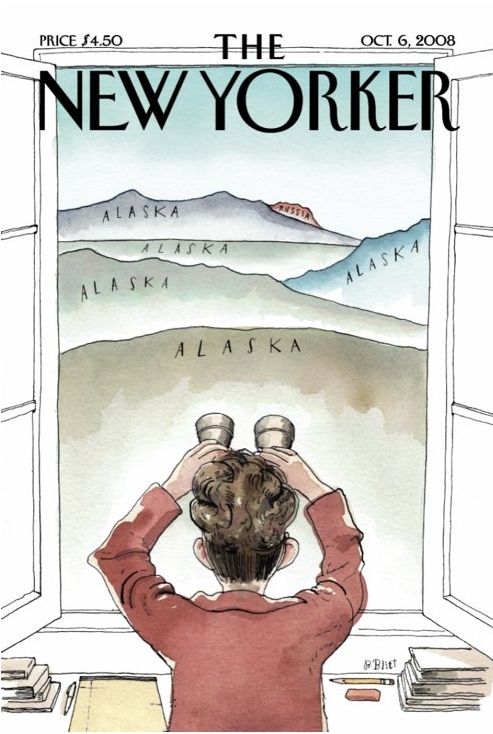
Prof. Ann Bartow can't muster up more praise for Sarah Palin than that she's "bright and energetic" and "would bring a very different package of life experiences to the job." Like aerial hunting, I guess -- something to keep in mind next time there's a protest march on the Mall. But Bartow is dead-set against Joe Biden and criticizes him regularly, though she always leaves out of her complaints the fact that Biden co-authored the Violence Against Women Act. So today Bartow posted yet another "leave Sarah alooooooooone!" entry to the Feminist Law Profs Blog, in response to this week's cover of The New Yorker:
I’m not a Palin partisan, but the ridicule she is enduring seems to far exceed what is being thrown at the very gaffe prone and not particularly progressive Joe Biden, or so it seems to me, and I have to belive [sic] it is due at least in part to her gender. [Links removed.]
This is nonsense, for at least three reasons. First, Biden has had plenty of ridicule leveled at him. He's been taking it for years, and has two previous failed bids at the Presidency to show for it.

Second, the New Yorker cover in question refers to Tina Fey's first Palin satire, when she said, "And I can see Russia from my house!" It's an homage to the famous 1976 Saul Steinberg "View of the World" cover and shows a woman with Palin-style hair looking out her window, over Alaskan hills, to Russia in the far distance. Obviously, then, this new cover refers to the McCain-Palin campaign's completely absurd claim that Alaska's proximity to Russia, without more, somehow magically confers foreign policy experience on a governor of that state. (And remember that Palin sidestepped the issue when Charles Gibson asked her to clarify, by feeding him a strange lie that Alaska produces "nearly 20 percent of the U.S. domestic supply of energy.")

Third, Palin and the McCain-Palin campaign are running a campaign based largely on her being a female candidate. Palin was chosen to try to win over disaffected Hillary Clinton supporters. She was chosen because her feminine charm and (relative) youth offset McCain's grizzled old soldier character and appearance. She was chosen in the hopes that some women will simply knee-jerk vote for a female candidate.

The McCain-Palin campaign has put forth her her gender as one of the main reasons you should vote for John McCain for president. She mentions that she's a mother of five in her speeches and interviews, as few and far between as they are. She bases her claimed experience for the vice presidency on being a vicious, but lipstick-wearing, hockey mom. This is deserving of ridicule. She and McCain have put her gender at issue from the moment McCain picked her as his running mate. So Sarah Palin shouldn't be heard to complain that some of the "ridicule" she gets is based upon her gender!

The New Yorker cover is a welcome and even-handed criticism of Palin after that magazine's inexplicably racist and simply out-to-lunch Obama family "terrorist" cover from July. The cover is a brava to Tina Fey's Palin impersonations. But the cover is not out of line. Rather, it's a fair criticism of an absolutely inadequate candidate and the lying presidential campaign that brought her on.

It's simple, really. Palin gets more ridicule than Biden because she deserves it more than he does. And she'll get no sympathy from me.

10 September 2008

Plea for context and actual commentary at Feminist Law Professors

Will the folks at the Feminist Law Professors blog please quit posting a billion times per day articles that are nothing but links around words like "This." or "Amazing article." or "Here." or "Via."?

I'm sure what you're linking to is incisive, important, relevant, and all those good things. But when you don't provide context I have no clue what your link is about. And when you don't provide commentary, you sound as though you don't have any thoughts of your own to add to the conversation. Is Feminist Law Professors a blog, or is it just a news aggregator? At least Fark.com contributors write witty headlines.

I'm not asking for some super-deep analysis that would get an A on a law school exam, or something so scholarly that it could be reprinted in a law review. But I don't think it's too much to ask for more than a bare link to some web page, where even the URL I see when I mouse over it doesn't give me a clue as to what I'm about to read.

19 July 2008

It's not sex discrimination to require a receptionist to make the boss's coffee

A couple of weeks ago, the Feminist Law Professors blog posted a criticism about a recent Title VII (sex discrimination) case. I disagreed with the article's conclusion and composed a brief comment, but a moderator decided not to post it. So I'll post an expanded version now, and, if anybody there notices, they're welcome to come on over and wipe the floor with me. I don't moderate comments here.

The case: Plaintiff was a newly hired receptionist whose boss required her to bring him coffee. She refused. She was fired, and she sued for gender discrimination, sexual harassment, and retaliation. The court sided with the boss, ruling that plaintiff had not alleged enough objectionable conduct to go to trial, and the case was dismissed (PDF).

I think the ruling was just fine, because the plaintiff was a bad fit for the job, and she had an unrealistic view of how much say she had in changing the job's requirements. Then, when she didn't get her way, she cried foul, using a tortured theory of sex discrimination.

Kathryn Stanchi, a Temple Law professor, had a much different view. Stanchi took the court to task for what she believes was a shallow analysis of the issue, an analysis that perpetuates "troubling and ingrained sexual stereotypes." One of Stanchi's problems with the decision is how the plaintiff was fired:
The plaintiff was fired 9 minutes after sending an email telling her boss that while she would get coffee for guests of the company, she did not expect that her job as receptionist and data entry clerk involved serving beverages to her male colleagues every day. Nine minutes! Talk about a short fuse.
Actually, the plaintiff was fired after several warnings, after a "make coffee" task was added to her daily work calendar, and after her supervisors had made it clear that making coffee for the boss (not her "colleagues") was an expected part of her job. Furthermore, her bosses allege, she was simply a lousy receptionist. She didn't transfer phone calls properly, she put mailing labels on packages incorrectly, and, though she was a customer service representative, she couldn't pronounce people's names.

And that e-mail message where she said she would be happy to fetch coffee for customers? Her bosses counter that she generally failed to do so.

Stanchi's next problem with the decision is that the judge didn't analyze the case deeply enough:
The judge never asks why it is acceptable for a receptionist/data entry clerk to be asked to get coffee. Women do that job (mostly), and women get coffee. End of (tautological) story.
Stanchi's issue with the decision, if I have it right, goes as follows: The judge decided the MSJ on the ground that no previous receptionist at this office had objected to making coffee. But because all the previous receptionists were women, and receptionist jobs in general are almost always filled by women, the judge should not have rested his decision there, because it would logically follow that no woman could ever experience sex discrimination if she's working in a job that is almost always exclusively filled by women.

I think Stanchi is missing the point.

I mean, I can't help asking myself after reading her commentary: Has Stanchi ever held a secretarial job? When you're a receptionist, making coffee for the office is par for the course. At least, that's what I've seen in my 15-plus years of experience in the secretarial trenches, on both coasts and in multiple industries. It doesn't matter whether you're female or male, though male receptionists are more likely to be called "interns" or "clerks." It doesn't matter whether part of your job is data entry because the office is small and everybody has to multi-task a little. The receptionist is at the bottom of the office totem pole, and so, of all the support staff in the office, the receptionist usually wins the task of making the boss's coffee.

Receptionist jobs are entry-level jobs. It's the type of job you get because you're young, or you haven't any other office experience, or you need something temporary. It's what you aim for to avoid restaurant work or work outdoors. It's the base office job, not one you get because you love answering phones, putting mailing labels on packages, and making coffee for the boss (though some would disagree). If you do the job well, you can move up the office ladder to secretary or administrative assistant, and then to executive assistant. Then you can branch out, if you like, and land a paralegal or an office manager job. Or, if you're smart, you're attending school at the same time so you can get off the administrative-support track altogether.

Plaintiff here had filed claims of sexual harassment, gender discrimination, and retaliation. In reality, she was fired for being a poor receptionist, and she played the Title VII card instead of owning her own problems and admitting that she didn't like being a receptionist.

A sales manager (a person nowhere in her chain of supervisors) sent her e-mail asking her out to lunch, and she got offended. That's not lawsuit-worthy. That's worth only a "no, thanks" reply with copies saved to a folder and a mental note to watch for further e-mail, in case the situation does indeed rise to the level of sexual harassment. As it stands, there is no reason to assume that the sales manager meant anything more than a friendly lunch. But even if he did intend the e-mail as asking her out for a date, it's still not sexual harassment. It was a single piece of e-mail.

Plaintiff also complained that she went to her boss's office for a meeting, and, when she got there, the sales manager and her boss were whispering and laughing, and they wouldn't tell her what they were talking about. How this incident is lawsuit-worthy is beyond my comprehension (but then, I'm a mere law student). She came upon a private conversation between two people, and they wouldn't share it with her. This was not sexual harassment. This was none of her business.

Plaintiff here wasn't being sexually harassed or discriminated against, and her firing wasn't retaliation. She just wasn't a good fit for the job. She thinks that a receptionist shouldn't have to bring coffee to the boss. She's perfectly within her rights to think so. Likewise, her boss was perfectly within his rights to think that a receptionist should have to bring coffee to the boss. She's a bad fit for the receptionist job at this workplace, and that's her problem.

An example in a different context: Say I'm a tour guide at a historical site where the guides switch posts throughout the day in 1-hour intervals. One of the posts, in particular, receives almost no visitors to guide, so I like to take a newspaper or novel with me when I'm posted there. My boss tells me that it's a sackable offense to read at any of the posts. I think this rule is unreasonable, especially on days when the site gets no visitors at all. The boss thinks it's a perfectly reasonable rule. We're both within our rights to think the way we do. But this disconnect makes me a bad fit for the tour guide job at that historical site, and that's my problem.

In short, when it comes to deciding what tasks are required for a job, especially a job that's so low on a scale of 9 to 5, it's not the employee who does the deciding.

It's not feminist to cry sexual harassment, gender discrimination, and retaliation when you lose your job. What's feminist is to do your job well and move up the ladder to the boss's job. Being an incompetent receptionist -- a job that basically requires only opposable thumbs and a pleasant demeanor for office guests -- and then suing your ex-boss for firing you, when you deserved it, makes all feminists look bad.

In a Legal Intelligencer article you can't see unless you have a password, plaintiff's attorneys say they "intend to appeal." I, for one, am not saying, "Thanks, guys."